|

At Stratford in the 70's, the text was all! And there, for the
first time, I tackled the problem of how to speak it. I had three
mentors - John Barton, again; Trevor Nunn,
another Cambridge friend; and Cicely Berry, the voice coach for the
Royal Shakespeare Company. Cis is small and shy, yet she radiates the
energy of a healer, as she lays her hands on your back, your ribs, your
neck, your forehead, soothing the body so that it can breathe freely and
confidently. She encourages the voice to express your individuality and
be responsive to the character you are playing. Your diaphragm muscle
below the lungs, pumps air from the body's centre, guiding it up over
the vocal chords, its passage hindered by nothing but your emotion, so
that feeling and sound are projected as one, over the lips, to sail
along the air, where they strike the audience's eardrums. Cis teaches
the intimacy of acting, regardless of the size of the auditorium. Actors
and audience should be physically connected — that's why I hate the
mechanical aids of microphone and loudspeakers.
 John
Barton's lessons are different but equally illuminating. He gets
together half- a-dozen actors, who singly learn a Shakespeare sonnet and
present it out loud to the rest of the group. It becomes a
self-contained speech, without any context of scene or play to
complicate matters. John then analyses it into the ground, whence, if
you're lucky, it grows, nurtured by his knowledge of the myriad devices
and flexibility of Shakespeare's poetry. When it comes to blank verse,
he is omniscient and it took him nine hour-long television programmes
(PLAYING SHAKESPEARE) to say the half of it. It was astonishing how few
of my colleagues at Stratford had time for the Barton classes. They
believed, perhaps, his reputation as a purely academic director.
Rubbish. John Barton is Mr. Show Biz. If a speech or scene isn't working
on its own in one of his productions, he will happily shove a bit of
atmospheric music underneath. He loves sound effects and smoke and dry
ice and elaborate scenery. When I came to do
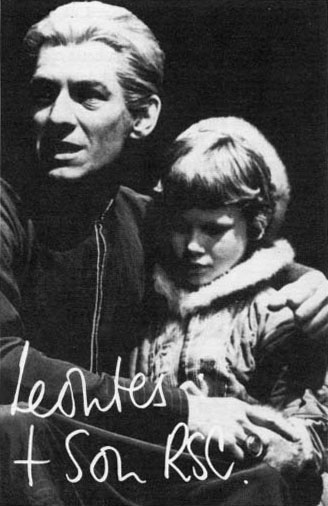
THE WINTER'S TALE with him, I found that the notoriously complex
text had had all the difficult lines cut out of it. I was playing
Leontes and, benefitting from my classwork, I did my newly-trained best.
For reasons never explained, the production had three directors, who
divided up the scenes between them for rehearsing. I cannot invent a
metaphor ridiculous enough to describe the confusion this caused. The
play was botched. John
Barton's lessons are different but equally illuminating. He gets
together half- a-dozen actors, who singly learn a Shakespeare sonnet and
present it out loud to the rest of the group. It becomes a
self-contained speech, without any context of scene or play to
complicate matters. John then analyses it into the ground, whence, if
you're lucky, it grows, nurtured by his knowledge of the myriad devices
and flexibility of Shakespeare's poetry. When it comes to blank verse,
he is omniscient and it took him nine hour-long television programmes
(PLAYING SHAKESPEARE) to say the half of it. It was astonishing how few
of my colleagues at Stratford had time for the Barton classes. They
believed, perhaps, his reputation as a purely academic director.
Rubbish. John Barton is Mr. Show Biz. If a speech or scene isn't working
on its own in one of his productions, he will happily shove a bit of
atmospheric music underneath. He loves sound effects and smoke and dry
ice and elaborate scenery. When I came to do
THE WINTER'S TALE with him, I found that the notoriously complex
text had had all the difficult lines cut out of it. I was playing
Leontes and, benefitting from my classwork, I did my newly-trained best.
For reasons never explained, the production had three directors, who
divided up the scenes between them for rehearsing. I cannot invent a
metaphor ridiculous enough to describe the confusion this caused. The
play was botched.
  
|