|
Words by Ian McKellen
The story of Rasputin, confidant of the last Tsarina of Russia, has
often been told on film. Tom Baker, Peter Cushing and Christopher Lee,
among others, have contributed to the enduring image of the "mad monk"
whose temporary healing of the Tsarevich's haemophilia so impressed his
parents but outraged their advisers, medical and political. In Uli
Edel's film for television, theatrically released in Europe, Alan
Rickman's performance outran his predecessors in believability. So too
the whole film, shot as it was in many of the locations of the actual
events which led up to the slaughter of the Russian royal family during
the civil war that preceded the establishment of the Soviet system that
replaced them.
 I
was intrigued to be cast as Tsar Nicholas, a gentle autocrat, much in
love with his wife and children but inadequate to lead a nation in
turmoil. In another version of the facts, Nicholas could be presented as
a tragic figure — a man miscast by destiny — but in this film he is
there to support the central story of the Tsarina's obsession with
Rasputin's hypnotic power. With some false hair augmenting my own wispy
beard, I managed to look a little like the Tsar, though the same was
true of Michael Jayston, who played him in Sam Spiegel's cinema version
Nicholas and Alexadra. I was taller than the real tsar. Just a few
years after coming out as a gay man (long thought to be an impediment to
playing straight characters) it is noteworthy that no-one complained
about my affectionate scenes with Greta Scacchi, and my
Golden Globe
Award as best supporting actor was a pleasant confirmation that my
career had not been knocked of course. I
was intrigued to be cast as Tsar Nicholas, a gentle autocrat, much in
love with his wife and children but inadequate to lead a nation in
turmoil. In another version of the facts, Nicholas could be presented as
a tragic figure — a man miscast by destiny — but in this film he is
there to support the central story of the Tsarina's obsession with
Rasputin's hypnotic power. With some false hair augmenting my own wispy
beard, I managed to look a little like the Tsar, though the same was
true of Michael Jayston, who played him in Sam Spiegel's cinema version
Nicholas and Alexadra. I was taller than the real tsar. Just a few
years after coming out as a gay man (long thought to be an impediment to
playing straight characters) it is noteworthy that no-one complained
about my affectionate scenes with Greta Scacchi, and my
Golden Globe
Award as best supporting actor was a pleasant confirmation that my
career had not been knocked of course.
Alan Rickman is a diligent and generous man. Five minutes after I
reached St Petersburg, he phoned up to my hotel room to invite me to
meet colleagues over dinner, although he had been filming all the long
day and might well have rested alone with room service. He did the same
with all the actors arriving from the UK to start work abroad. It's not
just that Alan is gregarious; rather that he wants the actors to work as
a team and whenever there was a need for a leader, he was there to play
that part as well as to play Rasputin. On the set it was the same; he
was always alert to other people's worries and supported them. Such
tone-setting behaviour is not usual from leading actors, nor is it a
contractual requirement.
Watching him at close quarters was instructive. Once I feel I have
played a scene as best I can, I long for the moment when the director
accepts my efforts and moves on to the next. Alan's special quest for
perfection shames me somewhat. He never wants to move on until he has
done better than his best. As Rasputin his acting style is broad yet
precise, outlandish yet subtle and is properly at the centre of the
spectacular architecture and crowd scenes which might otherwise have
stolen the show. His awards were well-deserved.
There were many extras, crowding the palaces and open-air scenes of
the film. Many of them were distinguished Russian stage actors earning a
modest dollar. One of the sadnesses of the removal of Communism has been
the declining fortunes of the artists which the Soviets valued so
highly. This made us privileged foreigners playing the main parts feel a
little uncomfortable. My hotel room cost more for one night than the
receptionist was paid in a month.
The costumes were tailored in the decrepit Mosfilm studios, where
the heating was scanty and the roof leaked. Our American producers noted
some inefficiencies amongst the locals and moved filming to Hungary
earlier than had been planned. Budapest, more used than Russia then was
to foreigners and their demands, was an easier location and doubled
convincingly for St Petersburg.
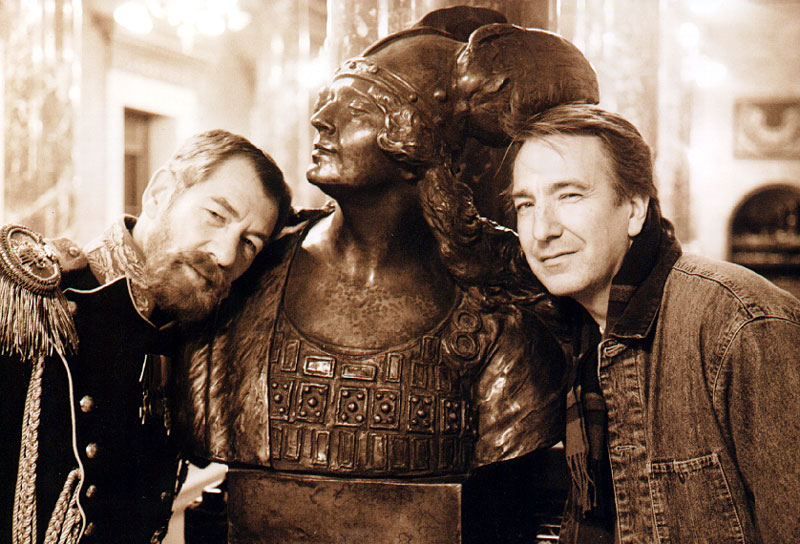
Ian McKellen and Alan Rickman on location at the Budapest Opera House
I enjoyed my time on and off screen with all the actors. Robert Lang
and I had been young members of Laurence Olivier's new
National Theatre Company in the mid-'60s. Before that, David Warner
played Borachio in
Much Ado About Nothing when
I made my professional Shakespeare debut as Claudio, at the Belgrade
Theatre in Coventry (1962). — Ian McKellen, June 2000
|